

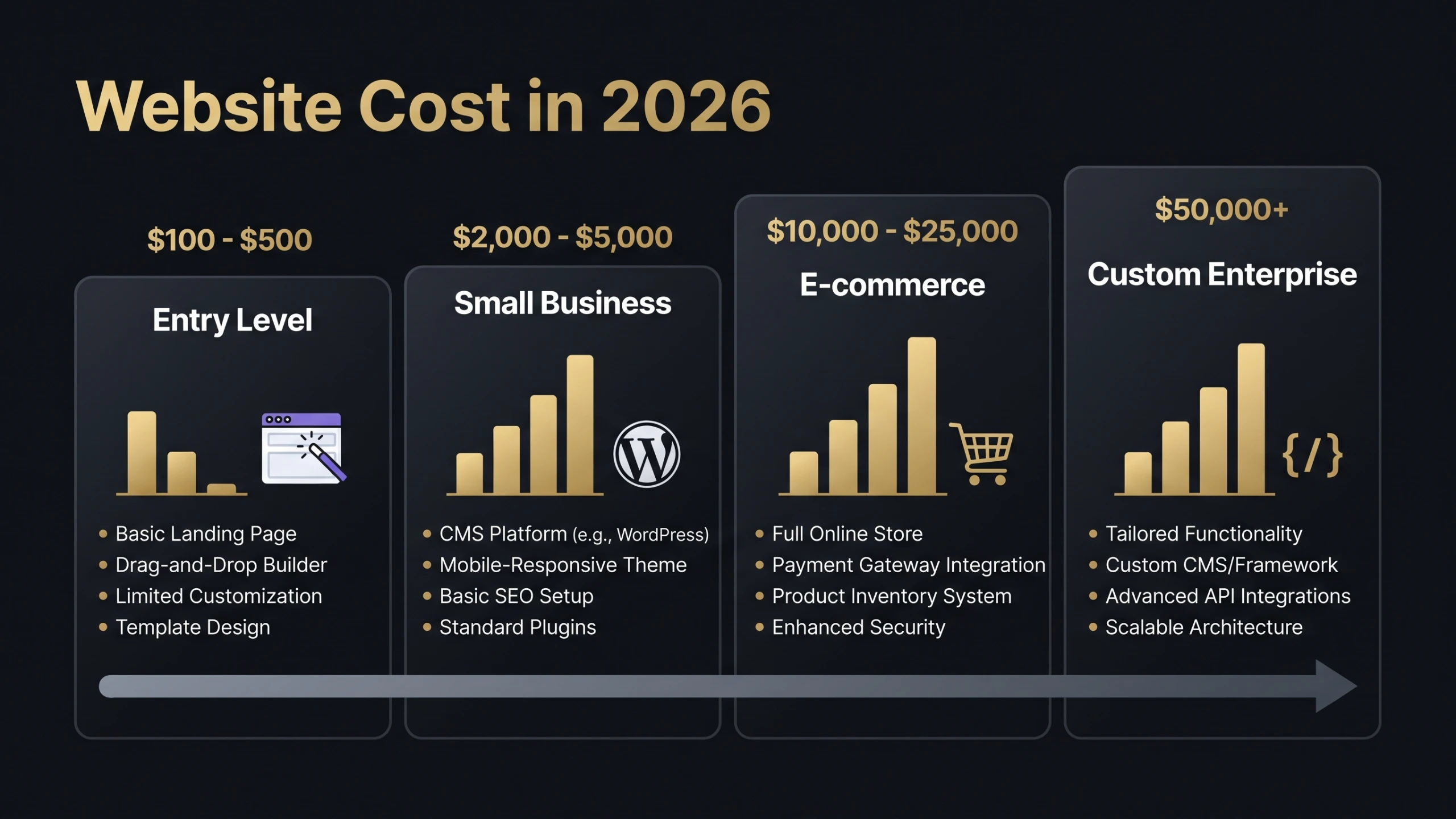
“How much does a website cost?” is one of the most googled questions by business owners — and unfortunately, it’s also one of the most inconsistently answered.
You’ll find quotes ranging from “completely free” to “$50,000+” depending on who you ask. A web design agency, a freelancer, a website builder platform, and a developer on Fiverr will all give you wildly different numbers for what sounds like the same thing.
The truth is: website costs in 2026 vary enormously based on how it’s built, who builds it, what features you need, and what your business goals are. In this guide, I’ll break down every option clearly — with real price ranges — so you can make an informed decision and never overpay or underspend on your website.
Why Website Costs Vary So Much
Before diving into numbers, it helps to understand why the range is so wide.
A “website” could mean:
- A one-page personal portfolio built on a free platform
- A 10-page business website on WordPress with a contact form
- A 50-page e-commerce store with payment processing, inventory, and custom checkout
- A fully custom web application with user accounts, dashboards, and API integrations
These are all “websites” — but they represent completely different scopes of work. That’s why quotes vary so dramatically.
The main factors that determine website cost are:
- Build method — DIY builder, WordPress, or fully custom code
- Who builds it — yourself, a freelancer, or an agency
- Number of pages — 5 pages vs 50 pages
- Design complexity — template-based vs bespoke custom design
- Features required — booking systems, e-commerce, membership portals, multilingual
- Ongoing costs — hosting, domain, maintenance, updates
Let’s go through each option in 2026.
Option 1: DIY Website Builders — $0 to $600/year
Website builders like Wix, Squarespace, Webflow, and GoDaddy let you build your own website without writing any code. You pick a template, drag and drop your content, and publish.
Price Breakdown
| Platform | Free Plan | Paid Plan (monthly) | Best For |
|---|---|---|---|
| Wix | ✅ Yes (with ads) | $17–$35/month | Small businesses, portfolios |
| Squarespace | ❌ No | $23–$49/month | Creatives, photographers |
| Webflow | ✅ Limited | $18–$29/month | Designers, custom layouts |
| GoDaddy | ✅ Limited | $10–$25/month | Very simple business sites |
Annual Cost Estimate
- Free plan: $0 (but includes platform ads and no custom domain)
- Basic paid plan: $150–$300/year (includes custom domain)
- Business plan: $300–$600/year (includes e-commerce features)
Pros
- Fast to set up — a basic site in a weekend
- No technical knowledge required
- Hosting included in the price
- Good for very small budgets
Cons
- Limited SEO control — you can’t fully optimise technical SEO
- Platform lock-in — you can’t easily move your site to another host
- Generic templates — harder to stand out from competitors
- Limited scalability — as your business grows, the platform may hold you back
- Ongoing monthly fees add up over time
Best for: Solopreneurs, hobbyists, very early-stage startups testing an idea.
Option 2: WordPress Website (Self-Hosted) — $200 to $5,000+
WordPress powers over 43% of all websites on the internet. It’s the most flexible, scalable, and SEO-friendly platform available — and it can be used at many different price points depending on who does the work.
WordPress Cost Components
Domain name: $10–$20/year Your website address (e.g., yourbusiness.com). Registered through GoDaddy, Namecheap, or Cloudflare.
Web hosting: $30–$360/year
- Budget shared hosting (Hostinger, SiteGround Starter): $30–$80/year
- Business hosting (SiteGround Business, Cloudways): $80–$200/year
- Managed WordPress hosting (Kinsta, WP Engine): $200–$600/year
Premium theme: $50–$100 (one-time) A professionally designed WordPress theme. Options include GeneratePress, Blocksy, or a custom-built theme like my own MensCreations theme.
Essential plugins: $0–$300/year
- SEO plugin (RankMath free or Yoast Premium: $99/year)
- Security plugin (Wordfence free or premium: $119/year)
- Caching plugin (WP Rocket: $59/year)
- Form plugin (WPForms or Gravity Forms: $49–$159/year)
Total DIY WordPress cost: $200–$600/year (if you build it yourself)
Hiring a WordPress Developer or Freelancer
If you hire someone to design and build your WordPress site, costs depend heavily on the developer’s experience and location:
| Developer Type | Typical Cost |
|---|---|
| Beginner freelancer (Fiverr/Upwork) | $150–$500 |
| Mid-level freelancer | $500–$2,000 |
| Experienced developer (like me) | $1,500–$5,000 |
| Local agency | $3,000–$10,000+ |
For a standard 5–10 page business website on WordPress with a custom design, SEO setup, contact forms, and mobile optimisation, expect to pay $1,000–$3,000 from an experienced freelance developer in 2026.
What You Get at Each Price Point
$500–$1,000: Template-based WordPress site, basic customisation, standard pages (Home, About, Services, Contact). Suitable for very small businesses with minimal online presence needs.
$1,000–$3,000: Custom-designed WordPress site, 5–15 pages, SEO-optimised structure, mobile-first design, Core Web Vitals optimised, contact forms, Google Analytics setup, basic security. This is the sweet spot for most small and medium businesses.
$3,000–$5,000: Advanced custom design, 15–30 pages, booking systems or basic e-commerce, custom post types, advanced SEO setup including schema markup, page speed optimisation, multiple revisions.
$5,000+: Complex WordPress builds — membership portals, WooCommerce stores with 50+ products, multilingual sites, custom plugins or integrations, enterprise-level security.
Option 3: E-Commerce Website — $1,000 to $20,000+
If you need to sell products online, your website costs increase significantly due to the complexity of payment processing, product management, inventory, and security requirements.
E-Commerce Platform Costs
| Platform | Setup Cost | Monthly Cost | Best For |
|---|---|---|---|
| WooCommerce (WordPress) | $0 plugin | $30–$200/month hosting | Full control, custom stores |
| Shopify | $0 | $39–$399/month | Fast setup, product-focused |
| Webflow + Commerce | $0 | $29–$212/month | Design-forward stores |
E-Commerce Development Cost
- Small Shopify store (under 50 products): $800–$3,000 for setup + theme customisation
- Custom WooCommerce store: $2,000–$8,000
- Large custom e-commerce build: $8,000–$20,000+
The biggest variable in e-commerce costs is the number of products, the complexity of the checkout flow, and whether you need custom integrations (inventory management, CRM, ERP systems).
Option 4: Custom-Coded Website — $5,000 to $50,000+
A fully custom website — built from scratch using HTML, CSS, JavaScript, and a backend framework (Node.js, Laravel, Django) without relying on WordPress or a website builder — represents the highest quality and highest cost option.
When You Need a Custom Build
- Your business has very specific functionality that no off-the-shelf platform can provide
- You need a web application with user accounts, dashboards, and complex data management
- You’re building a SaaS product or customer portal
- You need maximum performance and have zero tolerance for platform limitations
Custom Development Cost Ranges
| Scope | Price Range |
|---|---|
| Simple custom site (5–10 pages, no CMS) | $3,000–$8,000 |
| Custom site + CMS integration | $5,000–$15,000 |
| Web application (user accounts, data) | $10,000–$30,000 |
| Complex SaaS or enterprise platform | $30,000–$100,000+ |
Hidden Costs Most People Forget
One of the biggest surprises for first-time website owners is the ongoing costs after launch. Here’s what to budget for annually:
| Cost | Annual Estimate |
|---|---|
| Domain renewal | $10–$20/year |
| Web hosting | $30–$600/year |
| SSL certificate | Free (Let’s Encrypt) to $100/year |
| Premium plugins/themes renewal | $100–$400/year |
| Website maintenance & updates | $200–$1,200/year |
| Content updates (if outsourced) | $500–$3,000/year |
| SEO & performance monitoring | $100–$500/year |
Total annual running cost for a WordPress business site: $400–$2,500/year depending on your setup and how much ongoing work you need.
The Real Cost of a Cheap Website
It’s tempting to go with the lowest quote you find. But a cheap website often costs more in the long run.
A poorly built website typically has:
- Slow page speed → poor Core Web Vitals → lower Google rankings → less traffic
- No SEO setup → your pages don’t rank at all
- Poor mobile experience → visitors leave immediately
- Security vulnerabilities → risk of getting hacked
- No scalability → you need to rebuild it again in 2 years
I’ve had clients come to me after spending $300 on a website that received zero organic traffic for 12 months. The cost of rebuilding it properly — plus a year of lost business — far exceeded what a professional build would have cost from the start.
A good website is an investment, not an expense. When built correctly, it generates leads and customers 24/7. The ROI of a well-built, SEO-optimised website typically pays for itself within 6–12 months for most businesses.
For a deeper look at what makes a website perform well in Google, read my SEO Audit Checklist for 2026 and Core Web Vitals Guide.
How to Choose the Right Option for Your Budget
Here’s a simple decision framework:
Under $500/year total budget? → Use Wix or Squarespace on a paid plan. Accept the limitations and focus on content.
$500–$1,500 one-time budget? → Self-hosted WordPress with a quality theme. Hire a mid-level freelancer or learn to build it yourself using premium tutorials.
$1,500–$5,000 budget? → Hire an experienced WordPress developer for a properly built, SEO-optimised business website. This is the right investment for most small and medium businesses.
$5,000–$15,000 budget? → Full custom WordPress build or Webflow site with bespoke design, advanced features, and thorough SEO and performance setup.
$15,000+ budget? → Custom development, web application features, or enterprise-level WordPress multisite. Work with an experienced agency or senior developer.
Website Cost Summary Table
| Option | Build Cost | Annual Running Cost | Best For |
|---|---|---|---|
| Wix / Squarespace (DIY) | $0 | $200–$600 | Solopreneurs, tight budgets |
| WordPress (DIY) | $0 build | $200–$600 | Tech-savvy business owners |
| WordPress (Freelancer) | $500–$3,000 | $300–$800 | Most small businesses |
| WordPress (Agency) | $3,000–$10,000 | $400–$1,200 | Established businesses |
| Shopify Store | $800–$5,000 | $500–$5,000 | Product-based e-commerce |
| Custom Web App | $10,000–$50,000+ | $1,000–$5,000 | SaaS, complex platforms |
Frequently Asked Questions
How much does a website cost in 2026? Website costs range from $0 (DIY free builders) to $50,000+ (custom enterprise platforms). For most small businesses, a professionally built WordPress website costs $1,500–$3,000 to build, plus $300–$800/year in running costs.
How much does a WordPress website cost? WordPress itself is free. Total costs depend on hosting ($30–$360/year), domain ($10–$20/year), premium theme ($50–$100), plugins ($100–$300/year), and developer fees ($500–$5,000) if you hire someone to build it.
Is it worth paying for a professional website in 2026? Yes — for most businesses, absolutely. A professionally built, SEO-optimised website generates organic traffic, builds trust, and converts visitors into customers. A cheap or DIY website that ranks poorly costs you far more in lost business than a professional build would have.
What is the cheapest way to build a website in 2026? A free Wix or WordPress.com plan costs $0 but has major limitations. The best value option is self-hosted WordPress on Hostinger or SiteGround, which can be operational for under $100/year — but you’ll need to build it yourself or hire a developer.
Final Thoughts
There’s no single right answer to “how much does a website cost?” — because the right website for your business depends entirely on your goals, your audience, and your budget.
What I can tell you is this: the cheapest option is rarely the best value, and the most expensive option isn’t always necessary. The sweet spot for most small and medium businesses in 2026 is a professionally built WordPress website in the $1,500–$3,000 range — SEO-optimised, fast, secure, and scalable as your business grows.
If you’re unsure what type of website your business needs or what a fair budget looks like for your specific situation, get in touch with me. I’ll give you an honest assessment — no jargon, no upselling, just a clear recommendation based on what will actually work for your business.