

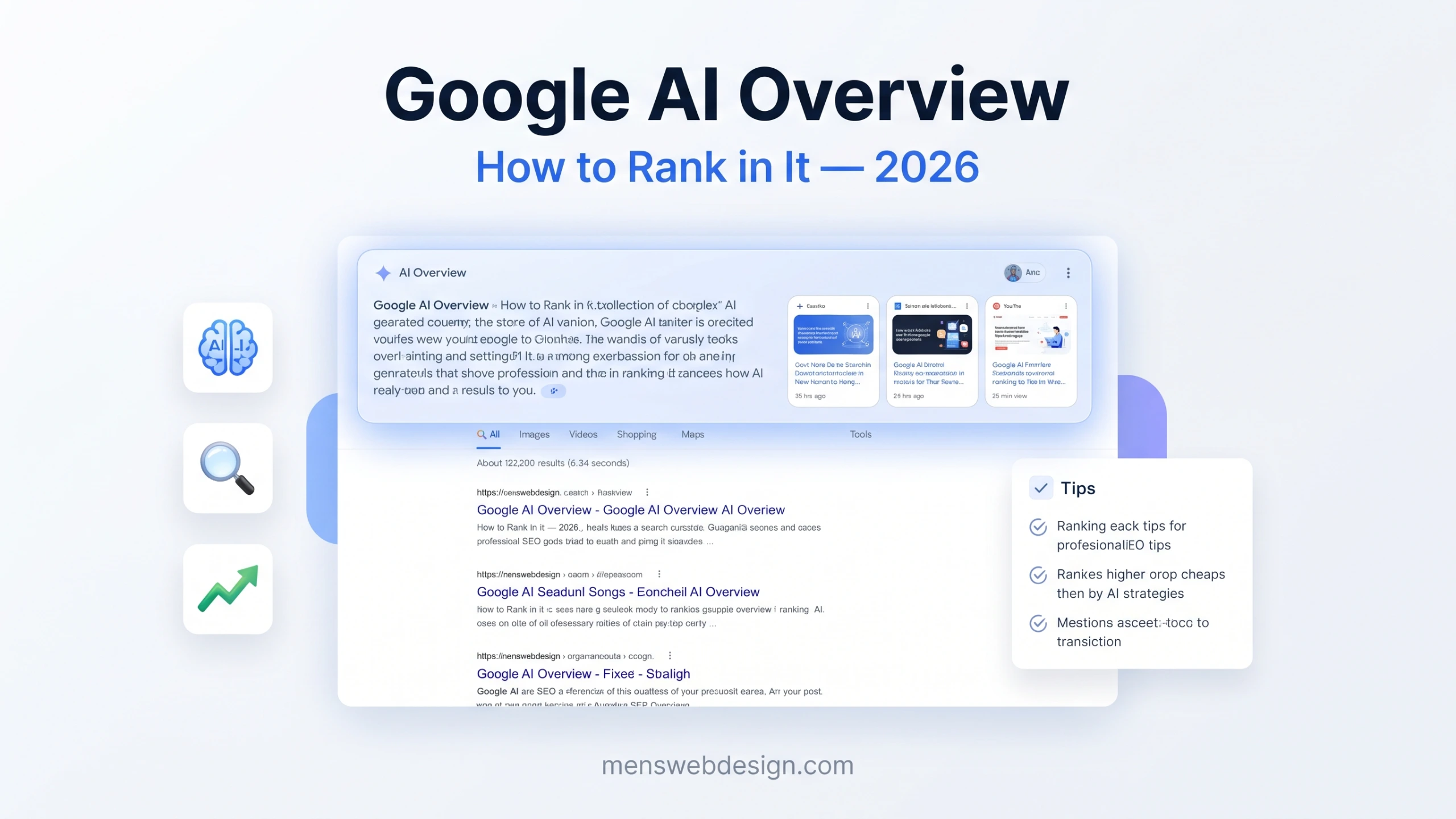
If you’ve searched on Google recently, you’ve almost certainly noticed something new at the very top of the results page — before any traditional blue links, before featured snippets, before ads. A large AI-generated summary that directly answers your question, with a few source links tucked alongside it.
That’s Google AI Overview. And in 2026, it’s one of the most important developments in SEO that every website owner and developer needs to understand.
Why? Because it’s fundamentally changing how Google presents information — and therefore how people interact with search results. If your website isn’t optimised for AI Overviews, you’re potentially invisible to a growing portion of Google’s search traffic.
In this guide, I’ll explain exactly what Google AI Overviews are, how they work, which websites get chosen as sources, and — most importantly — a practical step-by-step strategy to optimise your website to appear in them.
What Is Google AI Overview?
Google AI Overview (previously called Search Generative Experience or SGE during its testing phase) is Google’s AI-powered search feature that generates a synthesised summary answer at the very top of search results.
When you search for something like “how do I improve my website’s SEO,” instead of showing you just a list of links, Google now generates a multi-paragraph AI answer that:
- Summarises the key points from multiple trusted sources
- Presents them in clear, readable language
- Cites the source websites with links on the side or below
- Sometimes includes follow-up questions you can explore
Google AI Overview rolled out globally in May 2024 and has expanded significantly throughout 2025 and 2026. It now appears for a wide range of query types — informational questions, how-to queries, comparison searches, and even some commercial queries.
How Google AI Overview Works
Understanding how AI Overviews are generated is the first step to optimising for them.
Google’s AI Overview system uses a large language model (built on Google’s Gemini AI) that has been trained on a vast corpus of web content. When a user submits a query, the system:
- Identifies the query intent — is this a question, a how-to, a comparison, or a definition?
- Retrieves relevant sources — pulls from websites that Google’s systems already trust and index highly for this topic
- Synthesises a response — generates a new AI-written answer drawing from those sources
- Attributes sources — cites the websites it drew information from with clickable links
Critically, Google AI Overview does not simply copy-paste text from your website. It reads, understands, and rewrites the information in its own words — which is why traditional keyword stuffing won’t get you featured. What matters is the quality, clarity, and authority of your content.
AI Overview vs Featured Snippet: What’s the Difference?
Many people confuse AI Overviews with featured snippets. Here’s a clear comparison:
| Feature | Featured Snippet | Google AI Overview |
|---|---|---|
| Source | One single webpage | Multiple webpages |
| Content | Exact excerpt from your page | AI-generated synthesis |
| Length | Short paragraph or list | Multi-paragraph summary |
| Links | Links to source page | Links to multiple sources |
| Appearance | Box above results | Large panel at very top |
| Query types | Specific factual queries | Broad informational queries |
| Optimisation | Answer one question clearly | Cover topic comprehensively |
Both are valuable SEO goals — but they require somewhat different strategies. Featured snippets reward precision; AI Overviews reward depth and topical authority.
How Does Google Choose Which Websites to Cite?
This is the question everyone wants answered. Google hasn’t published a definitive algorithm for AI Overview source selection, but based on analysis of thousands of AI Overview citations in 2025–2026, several clear patterns emerge:
1. Topical Authority
Websites that consistently publish high-quality, in-depth content on a specific topic are significantly more likely to be cited. Google’s systems identify “topic experts” — sites that cover a subject comprehensively, not just casually.
If your website covers web development and SEO across multiple detailed posts, you’re more likely to be cited for web development queries than a general news site that published one article on the topic.
2. Content That Directly Answers Questions
AI Overviews are triggered by question-based queries. Content that clearly, directly, and concisely answers specific questions is favoured. This means using question-based headings (H2/H3) and answering them immediately in the paragraph below — not burying the answer three paragraphs down.
3. Structured, Scannable Content
Google’s AI finds it much easier to extract and synthesise information from well-structured content. Pages with clear headings, bullet points, numbered lists, definition-style explanations, and FAQ sections are cited more frequently than dense walls of text.
4. E-E-A-T Signals
Google’s quality framework — Experience, Expertise, Authoritativeness, and Trustworthiness — plays a central role in AI Overview source selection. Sites with:
- Author bio pages showing real credentials
- About pages explaining who runs the site
- References and citations to authoritative sources
- Positive user signals (low bounce rate, high time on page)
- Quality backlinks from trusted domains
…are significantly more likely to be chosen as AI Overview sources.
5. Technical SEO Health
A technically broken website — slow to load, with crawl errors, missing schema, or poor mobile experience — is less likely to be cited even if its content is excellent. Google needs to be able to efficiently crawl, index, and understand your pages.
6. Schema Markup
Pages with relevant schema markup — especially FAQ schema, HowTo schema, and Article schema — are more easily parsed by Google’s AI systems. Schema helps Google understand the structure and context of your content at a machine-readable level.
Does Google AI Overview Hurt Your Website Traffic?
This is the concern most website owners have — and it’s legitimate.
For some query types, AI Overviews do reduce click-through rates. If a user gets a complete answer from the AI summary, they may not click through to any source website. Studies in 2025 showed that AI Overviews appeared on roughly 15–25% of all searches, with click-through rates on traditional results dropping by 20–30% for queries where AI Overviews appeared.
However, the picture is more nuanced:
Where traffic drops:
- Simple factual queries (“what is X”, “definition of Y”)
- Basic how-to questions with short answers
- General knowledge questions
Where traffic holds or grows:
- Complex topics requiring detailed explanation
- Service and product pages (commercial intent)
- Local business queries
- Tutorial content requiring hands-on steps
- Content that AI Overviews cite as sources — these pages often see increased branded visibility
The strategic shift: In 2026, the goal is no longer just to rank on page one. It’s to be cited as a trusted source inside the AI Overview itself — and to create content that gives users a reason to click through for the full picture.
Step-by-Step: How to Optimise for Google AI Overview
Here is the practical optimisation strategy I use when building and auditing websites for AI Overview visibility.
Step 1: Build Topical Authority Through Content Clusters
Google’s AI favours websites that demonstrate deep expertise in a specific area. A single blog post on a topic won’t get you cited. A cluster of interlinked, comprehensive posts on related topics will.
Action: Map out your core topic area and create a content cluster:
- One pillar page covering the main topic broadly and in depth
- Multiple supporting posts covering specific subtopics in detail
- Strong internal links connecting all cluster content together
For example, my own blog covers Technical SEO as a core cluster — with posts on Core Web Vitals, SEO Audits, WordPress SEO, and Google Rankings — all interlinked, building topical authority on Technical SEO as a whole.
Step 2: Write Content That Directly Answers Questions
For every piece of content you publish, identify the primary question it answers and make sure that answer is:
- In the first 1–2 paragraphs (don’t make Google’s AI dig for it)
- Written in plain, clear language
- Followed by deeper explanation and context
Use question-based H2 and H3 headings throughout your content:
- “What is [topic]?”
- “How does [topic] work?”
- “Why does [topic] matter?”
- “How do I fix [problem]?”
Step 3: Add FAQ Sections With Schema Markup
FAQ sections are one of the most reliable ways to appear in both AI Overviews and featured snippets. Every blog post and service page should end with a FAQ section covering 3–5 common questions about the topic.
Back every FAQ section with FAQ schema markup (JSON-LD) — see the schema section at the top of this document for the correct format. This makes your Q&A content machine-readable and significantly increases the chance Google’s AI pulls from it.
Step 4: Strengthen Your E-E-A-T Signals
Update every page and post to include clear author information:
- Add an author bio box at the bottom of every blog post with your name, credentials, and a link to your About page
- Write a detailed About page that clearly explains your expertise and experience
- Add your LinkedIn profile link to your site
- Cite credible external sources within your content (studies, official documentation, reputable publications)
- Display client testimonials, case studies, and real project results
Step 5: Fix Your Technical SEO Foundation
AI Overviews only cite pages that Google can efficiently crawl, index, and understand. Run a full technical audit and fix:
- Page speed — target 90+ on Google PageSpeed Insights mobile
- Core Web Vitals — LCP under 2.5s, INP under 200ms, CLS under 0.1
- Crawl errors — check Google Search Console for any indexing issues
- Schema markup — add Article, FAQ, and BreadcrumbList schema to all posts
- Mobile usability — every page must pass Google’s mobile-friendly test
- HTTPS — your site must be fully secure
For a complete technical checklist, use my SEO Audit Checklist for 2026.
Step 6: Earn Quality Backlinks
Backlinks remain one of Google’s strongest trust signals — and they’re just as important for AI Overview citation as for traditional rankings.
Focus on:
- Guest posting on reputable websites in your industry
- Getting listed in industry directories and resource pages
- Creating genuinely shareable content (original data, comprehensive guides, tools)
- Building relationships with other content creators in your niche
You don’t need hundreds of backlinks. A handful of links from genuinely authoritative, relevant websites will do more for your AI Overview visibility than dozens of low-quality links.
Step 7: Optimise for Conversational and Long-tail Queries
AI Overviews appear most frequently for longer, more conversational queries — the kind people type when they genuinely want to understand something.
Optimise your content for:
- “How do I…” queries
- “What is the best way to…” queries
- “Why does…” queries
- “What is the difference between X and Y” queries
These align naturally with blog posts and guides — which is exactly why a strong blog strategy is one of the most powerful tools for AI Overview visibility in 2026.
The New SEO Mindset for 2026
Google AI Overview represents a fundamental shift in how search works — and how SEO needs to be approached.
The old SEO mindset: rank as high as possible for keywords so people click your link.
The new SEO mindset: become so authoritative and well-structured on your topic that Google’s AI cites you as a trusted source — and create content compelling enough that people click through for the full picture.
This shift actually rewards the things good content creators have always done: write clearly, cover topics thoroughly, demonstrate real expertise, and build genuine trust with your audience.
The websites that are thriving in AI-powered search in 2026 are the ones that were already committed to quality. The shortcut-seekers — thin content, keyword stuffing, low-quality link building — are finding that AI Overviews make their approach even less effective than before.
Your Google AI Overview Optimisation Checklist
Content:
- Content cluster built around your core topic area
- Each post directly answers a specific question in the first paragraph
- Question-based H2/H3 headings used throughout
- FAQ section at the end of every post (3–5 questions)
- Content is comprehensive — 1,500+ words for informational posts
Schema & Technical:
- FAQ schema added to every post with a FAQ section
- Article schema on all blog posts
- Page speed 90+ on mobile (PageSpeed Insights)
- Core Web Vitals all in “Good” range
- No crawl errors in Google Search Console
- HTTPS enabled and consistent
Authority & Trust:
- Author bio on every blog post
- Detailed About page with real credentials
- External citations to reputable sources in content
- Client testimonials and case studies on site
- Quality backlinks from relevant, authoritative sites
Internal Linking:
- All cluster content interlinked
- Each post links to 3–5 related posts
- Pillar page links to all supporting posts
- Supporting posts link back to pillar page
Frequently Asked Questions
What is Google AI Overview? Google AI Overview is an AI-generated summary that appears at the very top of Google search results, synthesising information from multiple trusted websites to directly answer a user’s query. It was rolled out globally in 2024 and is now a dominant feature of Google search in 2026.
How do I get my website featured in Google AI Overview? Focus on building topical authority through content clusters, writing content that directly answers questions, adding FAQ sections with schema markup, strengthening E-E-A-T signals, fixing technical SEO issues, and earning quality backlinks from trusted sources.
Does Google AI Overview hurt website traffic? For simple informational queries, AI Overviews can reduce click-through rates. However, websites cited as sources gain brand visibility, and complex or commercial content still drives strong click-through. The strategic focus should shift to being cited as a source and creating content that users need to click through to fully benefit from.
Is Google AI Overview the same as featured snippets? No. Featured snippets pull an exact excerpt from one webpage. AI Overviews synthesise information from multiple sources and generate a new AI-written summary. Both appear above regular results but require different optimisation strategies.
Final Thoughts
Google AI Overview isn’t a trend to watch — it’s already reshaping how millions of people interact with search results every day in 2026. The businesses and websites that adapt their SEO strategy now will have a significant advantage over those that wait.
The good news is that the strategy for ranking in AI Overviews is fundamentally aligned with good SEO and good content creation: be genuinely helpful, cover your topic thoroughly, demonstrate real expertise, and make your content easy for both humans and machines to understand.
If you’d like a professional review of your website’s AI Overview readiness — or help building a content strategy that positions you as a trusted source in Google’s AI results — get in touch with me. This is exactly the kind of Technical SEO work I do for clients.