

Something significant has been happening in search over the last two years — and most website owners haven’t caught up yet.
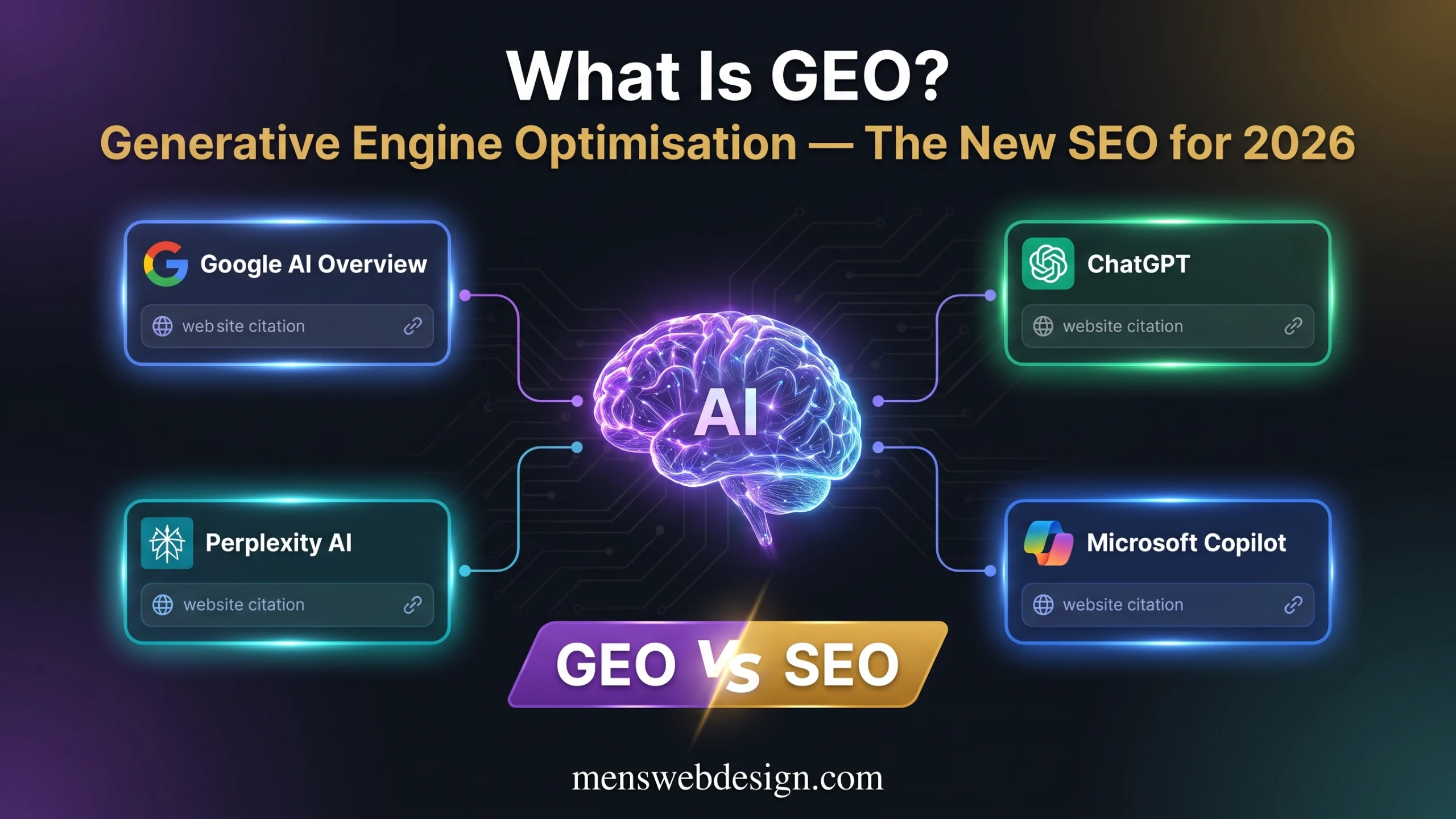
When people search on Google in 2026, they increasingly get an AI-generated answer at the very top of the page — before any traditional blue links. When they ask ChatGPT a question, it generates a response that cites specific websites as sources. When they use Microsoft Copilot or Perplexity AI, the same thing happens.
The rules of getting found online are changing. Traditional SEO — ranking as a blue link — is still important. But there’s now a new game running in parallel: getting your website cited as a source by AI-powered search engines.
That new game has a name: Generative Engine Optimisation — GEO.
In this guide, I’ll explain exactly what GEO is, how it differs from traditional SEO, which AI search engines it applies to, and — most importantly — a practical step-by-step strategy to start optimising your website for AI search in 2026.
What Is Generative Engine Optimisation (GEO)?
Generative Engine Optimisation (GEO) is the practice of optimising your website and content to be cited, referenced, or used as a source by AI-powered search engines that generate their own written responses.
The term was first formally introduced in a research paper published by Princeton, Georgia Tech, The Allen Institute for AI, and IIT Delhi in 2023 — making it one of the newest and fastest-growing disciplines in digital marketing.
Here’s the core idea:
Traditional search engines (Google, Bing) act as indexers — they find your content, rank it, and present it as a clickable link. Users choose whether to click.
AI-powered search engines (Google AI Overview, ChatGPT, Perplexity) act as synthesisers — they find your content, read it, rewrite it into their own words, and present their generated answer directly to the user. Your website may be cited as a source — or it may not be cited at all.
GEO is the strategy of making sure your content gets chosen as one of those cited sources.
The AI Search Landscape in 2026
To understand GEO, you need to understand which AI search tools are now actively pulling from websites:
Google AI Overview
The most important for most websites. Google AI Overview appears at the very top of Google Search results for a growing range of queries — generating AI-written summaries that cite multiple web sources. It’s powered by Google’s Gemini AI and uses Google’s existing index.
Coverage: Billions of searches per month. Optimising for Google AI Overview is the highest-priority GEO task for most websites.
ChatGPT (with Web Browsing)
OpenAI’s ChatGPT can now browse the web in real time to answer questions. When users ask ChatGPT about current topics, it retrieves and synthesises information from live websites — citing sources with links.
Coverage: Hundreds of millions of users. Growing rapidly as a research and discovery tool.
Microsoft Copilot (Bing AI)
Microsoft’s AI assistant, integrated into Bing search and Microsoft 365, generates AI responses from web content with citations. Uses Bing’s index.
Coverage: Significant enterprise and Windows user base.
Perplexity AI
A dedicated AI search engine that generates comprehensive, cited answers from web sources. Particularly popular among researchers, developers, and technical audiences.
Coverage: Rapidly growing, especially among high-value professional audiences.
Other Emerging AI Tools
AI assistants embedded in browsers, productivity tools, and apps are increasingly capable of searching the web — each one representing an additional channel where your content could be cited (or missed).
GEO vs SEO: What’s the Difference?
This is the most important distinction to understand before diving into strategy.
| Factor | Traditional SEO | GEO |
|---|---|---|
| Goal | Rank as a blue link in search results | Be cited as a source in AI responses |
| Success metric | Ranking position, click-through rate | Citation frequency, brand mentions in AI |
| How it works | Algorithms rank pages by relevance & authority | AI synthesises content from trusted sources |
| Content style | Keyword-optimised, structured for rankings | Authority-focused, clearly written, comprehensive |
| Key signals | Backlinks, keywords, technical health | E-E-A-T, topical authority, content clarity |
| Schema markup | Helps with rich results | Helps AI parse and understand content |
| Result type | Clickable link — user visits your site | AI summary — user may not click at all |
| Traffic impact | Direct traffic from clicks | Indirect — brand awareness + some clicks |
The Critical Difference: Clicks vs Citations
This is where GEO gets strategically complex.
With traditional SEO, success means getting a click. Someone sees your link and visits your site.
With GEO, success means getting cited. The AI generates an answer that mentions or links to your site — but the user may get what they need from the AI response without ever visiting you.
This means GEO serves two different goals simultaneously:
- Brand authority — being cited by AI makes your brand appear trustworthy and authoritative, even if users don’t click
- Traffic — some users will click your cited link for more detail, especially for complex topics
Businesses that focus purely on clicks will struggle to measure GEO’s value. The metric that matters is: Is my brand being mentioned as a trusted source in AI responses?
Does GEO Replace SEO?
No — and this is crucial to understand.
Traditional SEO is not dead. Blue link rankings still drive the majority of organic website traffic in 2026. The websites that appear in AI Overview citations are almost always websites that already rank well traditionally.
Think of GEO and SEO as two layers of the same strategy:
- SEO gets you into Google’s index, builds your authority, and drives direct click traffic
- GEO gets you cited in AI responses, builds brand awareness, and captures AI-influenced traffic
The good news: most GEO best practices are also excellent SEO practices. Investing in GEO doesn’t pull resources away from SEO — it amplifies both simultaneously.
The websites winning in AI search in 2026 are the ones that built strong SEO foundations and are now layering GEO optimisation on top.
For your SEO foundation, see my SEO Audit Checklist 2026 and Google AI Overview guide.
The 7 Core GEO Optimisation Strategies
Here is the complete GEO strategy I apply when optimising websites for AI search visibility in 2026.
Strategy 1: Build Deep Topical Authority
AI search engines don’t cite random websites. They cite websites that demonstrate sustained, deep expertise on a specific topic.
A single blog post about web development won’t get you cited. A website with 15+ interconnected, comprehensive posts covering web development, SEO, performance, and tools — all interlinked — signals to AI systems that your site is a genuine authority on the subject.
Action steps:
- Map out your core topic area and all the subtopics within it
- Create a content cluster — one pillar page covering the main topic, supported by detailed posts on each subtopic
- Interlink all cluster content so AI can follow the connections between topics
- Publish consistently — frequency signals active, maintained expertise
This is exactly what I’ve been building at menswebdesign.com — a growing cluster of interconnected Technical SEO and Web Development posts that collectively build topical authority across the entire subject area.
Strategy 2: Write for AI Comprehension — Clarity Over Cleverness
AI systems process your content differently from human readers. A clever headline, a witty metaphor, or an ambiguous statement that a human reader finds engaging can confuse an AI trying to extract factual information.
Write for clarity:
- State the main point of each section in the first sentence — don’t bury the lead
- Use simple, direct language — plain English outperforms jargon
- Define terms explicitly — “GEO (Generative Engine Optimisation) is…”
- Use short paragraphs — 2–4 sentences maximum
- Avoid ambiguity — be precise about what, who, when, where, and how much
The clearer your content, the more accurately an AI can extract and cite it.
Strategy 3: Answer Specific Questions Directly
AI search engines are triggered by questions. Their entire purpose is to answer what someone asked. Content that directly answers specific questions is far more likely to be cited than content that discusses a topic generally.
Structure your content around questions:
- Use question-based H2 and H3 headings: “What is GEO?”, “How does GEO work?”, “What is the difference between GEO and SEO?”
- Answer each question immediately below the heading — in the first 1–2 sentences
- Add comprehensive context after the direct answer
- End every major post with a FAQ section covering the most common questions about the topic
Pro tip: Research the questions people actually ask. Google’s “People Also Ask” section, Answer the Public, and Reddit threads in your niche are gold mines for question-based content ideas that AI systems actively look to answer.
Strategy 4: Maximise E-E-A-T Signals
Experience, Expertise, Authoritativeness, and Trustworthiness — Google’s quality framework — is also the framework AI systems use to evaluate which sources to cite. Low E-E-A-T websites are rarely cited regardless of their content quality.
Concrete E-E-A-T improvements:
Experience:
- Include real examples from your own work — “When I redesigned the Center for Lean Excellence website, I found…”
- Share specific data, results, and outcomes from real projects
- Include case studies with before/after metrics
Expertise:
- Author bio on every post with your credentials and years of experience
- Link your LinkedIn profile and other professional profiles
- Cite credible external sources (studies, official documentation, authoritative publications)
Authoritativeness:
- Earn backlinks from reputable websites in your niche
- Get mentioned or quoted in industry publications
- Publish original research or data that other sites cite
Trustworthiness:
- HTTPS on every page
- Clear About page with real identity information
- Contact information visible and accurate
- Privacy Policy and Terms of Service published
- No misleading claims or unsubstantiated statements
Strategy 5: Use Schema Markup Extensively
Schema markup is the language that helps AI systems understand the structure and context of your content at a machine-readable level. Websites with comprehensive schema markup are significantly more likely to be cited in AI responses.
Priority schema types for GEO:
- Article / BlogPosting — on every blog post
- FAQPage — on every post with a FAQ section
- Person — on your About page establishing your identity
- Organization — on your homepage
- BreadcrumbList — on every page
- HowTo — on step-by-step tutorial content
For a complete schema markup implementation guide, read my Schema Markup Guide 2026.
Strategy 6: Optimise for Brand Mentions and Citations
AI systems learn from patterns across the web. When multiple authoritative sources mention your brand or website by name in a positive context, AI systems begin to associate your brand with authority in your topic area.
How to increase brand mentions:
- Guest posting — contribute articles to reputable websites in your niche; your author bio and brand get mentioned
- Podcast appearances — many podcast transcripts are indexed and crawled
- Digital PR — get mentioned in industry news and roundup articles
- Community participation — answer questions on Reddit, Quora, and Stack Overflow (your profile links back to your site)
- Testimonials and case studies — when clients mention you on their sites, that’s a brand citation
- Interviews and expert roundups — being quoted as an expert in roundup posts creates citations
The goal is a growing web of brand mentions across the internet that signals to AI: this person/brand is genuinely known and trusted in their field.
Strategy 7: Maintain Technical SEO Excellence
AI systems can only cite content they can find, crawl, and understand. Technical SEO failures — slow pages, crawl errors, missing sitemaps, poor mobile experience — prevent AI from accessing your content regardless of how good it is.
Technical GEO checklist:
- Google Search Console set up — no crawl errors
- XML sitemap submitted and up to date
- All pages load in under 2.5 seconds (LCP)
- Mobile experience passes Google’s mobile-friendly test
- HTTPS enabled sitewide
- Robots.txt not blocking important pages
- All images have descriptive alt text
- Internal linking connects all cluster content
- No broken links or 404 errors on important pages
For a full technical audit, use my SEO Audit Checklist 2026.
How to Measure GEO Success
Measuring GEO is different from measuring traditional SEO — because the goal isn’t always a click.
Key GEO metrics to track:
1. AI Citation Frequency Manually search for your key topics in Google AI Overview, ChatGPT, and Perplexity AI. Note how often your website appears as a cited source. Track this weekly.
2. Brand Mentions Use Google Alerts (free) for your brand name and key phrases. Track how often your brand is mentioned across the web — increasing mentions correlate with increasing AI citation probability.
3. Direct Traffic Track direct traffic in Google Analytics 4. Users who discover your brand through AI citations often return directly — typing your URL or brand name into their browser.
4. Branded Search Volume Monitor Google Search Console for searches containing your brand name. Growing branded search volume indicates AI tools are introducing your brand to new audiences.
5. Referral Traffic from AI Tools Check GA4 Referral traffic for sources like perplexity.ai, chat.openai.com, and bing.com/chat. This is direct, measurable traffic from AI search tools.
GEO in Practice: A Real Example
Let me show you how GEO works with a concrete example from my own website.
When someone asks Google AI Overview: “How do I fix Core Web Vitals on WordPress?” — Google’s AI synthesises an answer from multiple trusted sources. My post Core Web Vitals 2026 Developer Guide is a candidate to be cited because:
✅ It covers the topic comprehensively — 2,000+ words ✅ It answers specific questions with clear H2/H3 headings ✅ It includes platform-specific advice (WordPress, Webflow, Shopify) ✅ It has Article schema and FAQ schema with JSON-LD ✅ It’s part of a topical cluster covering all aspects of Technical SEO ✅ The author (me) has a bio establishing real expertise ✅ The page loads fast and passes Core Web Vitals
Every one of those factors is a GEO signal. Together, they make the post a strong candidate for AI citation — not just a traditional blue link ranking.
The GEO Strategy Checklist
Topical Authority:
- Content cluster built around your core topic
- 10+ interlinked posts covering all major subtopics
- Pillar page linking to all cluster content
- Consistent publishing schedule
Content Quality:
- Every post directly answers a specific question
- Question-based H2/H3 headings throughout
- FAQ section at the end of every major post
- Clear, jargon-free writing
- Real examples and data from your own experience
E-E-A-T:
- Author bio on every post
- Detailed About page with real credentials
- External citations to authoritative sources
- Case studies with real results
- Professional profiles linked (LinkedIn, etc.)
Technical:
- All schema types implemented correctly
- Core Web Vitals all in Good range
- No crawl errors in Google Search Console
- Mobile-friendly test passed
- Internal linking strong across cluster
Brand Authority:
- Guest posts on reputable external sites
- Brand mentions monitored via Google Alerts
- Community participation (Reddit, Quora, forums)
- Testimonials and case studies visible on site
Frequently Asked Questions
What is Generative Engine Optimisation (GEO)? GEO is the practice of optimising your website content to be cited as a source by AI-powered search engines like Google AI Overview, ChatGPT, and Perplexity AI. Unlike traditional SEO which targets blue link rankings, GEO targets inclusion in AI-generated responses.
What is the difference between SEO and GEO? Traditional SEO ranks your page as a clickable link. GEO gets your content cited in AI-written answers. SEO focuses on ranking position; GEO focuses on being used as a trusted source by AI. Both are needed in 2026 — they are complementary strategies.
Which AI search engines does GEO apply to? GEO applies to Google AI Overview, ChatGPT with web browsing, Microsoft Copilot, Perplexity AI, and any AI tool that retrieves and synthesises information from the web. Google AI Overview is the highest priority for most websites due to its massive reach.
Does GEO replace SEO? No. Traditional SEO still drives the majority of organic traffic and remains essential. GEO is an additional optimisation layer that extends your visibility into AI-generated search results. The good news: most GEO best practices also improve traditional SEO rankings.
Final Thoughts
GEO is not a future trend to watch — it’s a present reality that’s reshaping how websites get discovered in 2026.
The businesses and websites winning in AI search right now are the ones that built strong content foundations, demonstrated genuine expertise, structured their content clearly, and earned real authority in their niche. In other words — the ones that were already doing great SEO.
If you’re starting from scratch, the path is clear: build topical authority, answer questions clearly, demonstrate real expertise, implement schema markup, and keep your technical SEO foundation solid.
GEO rewards the same things great SEO always has — just through a different lens.
If you’d like help building a GEO-optimised content strategy for your website or auditing your current setup for AI search visibility, get in touch with me. This is exactly the kind of forward-thinking Technical SEO work I specialise in.