

If you’ve ever asked a web designer to build you a website and they came back asking whether you want a “home page” or a “landing page,” you might have felt momentarily confused.
Aren’t they the same thing?
Not at all — and confusing the two is one of the most common and costly mistakes businesses make online. Using the wrong type of page in the wrong situation can hurt your SEO, tank your conversion rates, and waste your ad budget.
In this guide, I’ll break down exactly what a home page is, what a landing page is, how they’re different in structure and purpose, how each affects your SEO, and — most importantly — when to use each one.
What Is a Home Page?
Your home page is the front door of your website. It’s the page visitors land on when they type your domain directly into a browser — yourwebsite.com — and it serves as the central hub from which everything else on your site is accessible.
A home page has to do a lot of jobs at once. It needs to:
- Introduce your brand — who you are, what you do, why you exist
- Serve multiple types of visitors — new visitors, returning customers, people researching, people ready to buy
- Provide navigation — links to your services, about page, blog, portfolio, contact
- Establish trust — testimonials, logos, certifications, social proof
- Guide visitors deeper into the site with multiple calls-to-action (CTAs)
Because a home page serves so many different purposes and audiences, it typically contains a lot of content, multiple sections, and several different CTAs pointing in different directions.
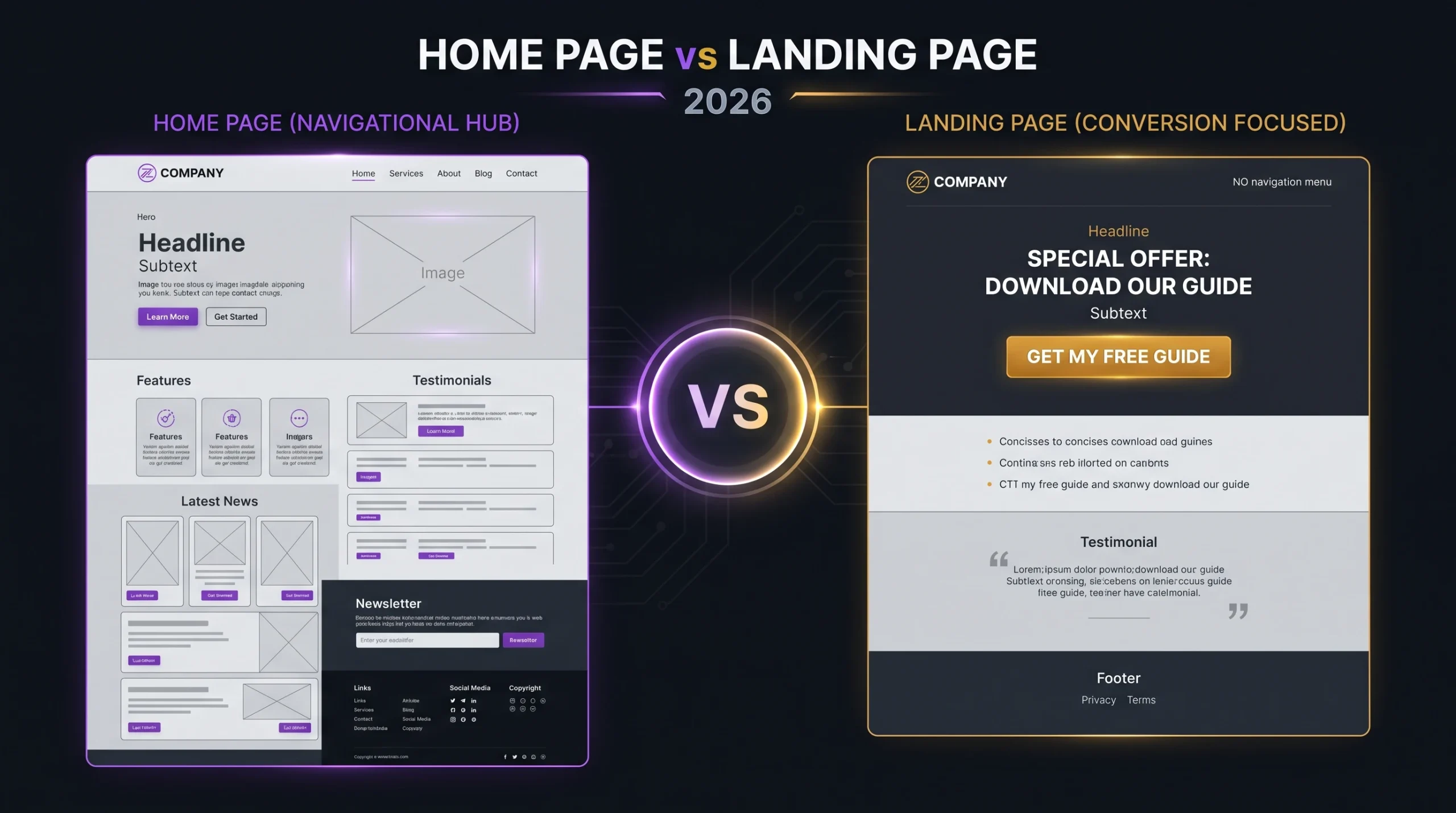
Typical home page structure:
- Navigation menu with links to all main pages
- Hero section — main headline + primary CTA
- Value proposition — what makes you different
- Services or product overview
- Social proof — testimonials, client logos, case studies
- Supporting sections — features, process, team
- Secondary CTAs throughout
- Footer — links to all key pages and auxiliary content
What Is a Landing Page?
A landing page is a standalone page created for one specific purpose: to convert a visitor into a lead or customer.
Unlike a home page, a landing page is laser-focused. It has:
- One message — targeted to a specific audience or campaign
- One goal — a single conversion action (sign up, buy, book a call, download)
- One CTA — everything on the page drives toward a single action
- No navigation menu — removing the nav eliminates distractions and keeps visitors focused
The term “landing page” comes from the idea that visitors “land” on it from a specific source — a Google Ad, a Facebook Ad, an email campaign, or a social media post. Because you control exactly where they came from, you can tailor the page’s message to match that specific source.
Typical landing page structure:
- No navigation menu (or a minimal logo-only header)
- Headline — directly addressing the visitor’s pain point or desire
- Subheadline — reinforcing the offer
- Key benefits — why this offer is right for them
- Social proof — focused testimonials or trust signals relevant to the offer
- Single CTA — repeated 2–3 times throughout the page
- Minimal footer — often just legal links, no full navigation
Home Page vs Landing Page: Side-by-Side Comparison
| Feature | Home Page | Landing Page |
|---|---|---|
| Purpose | Introduce brand, hub for site | Convert one specific audience |
| Navigation | Full navigation menu | None (or minimal) |
| CTAs | Multiple, pointing different directions | One CTA, repeated |
| Audience | All visitor types | One specific segment |
| Content depth | Broad overview of everything | Deep focus on one offer |
| Traffic source | Organic search, direct, referral | Paid ads, email, social campaigns |
| SEO value | High — targets brand + main keywords | Low — not built for organic ranking |
| Conversion focus | Low to medium | Very high |
| Links out | Many internal links | Very few or none |
The Core Difference: One Goal vs Many Goals
The most fundamental difference between a home page and a landing page is the number of goals each page is trying to achieve.
A home page serves many goals simultaneously — it needs to appeal to a first-time visitor who’s never heard of you, a returning customer looking for support, a journalist researching your company, and a potential employee wondering about your culture. It’s designed for exploration.
A landing page serves exactly one goal. If the goal is to get someone to book a free consultation call, every single element on that page — the headline, the imagery, the bullet points, the testimonials, the button — exists solely to move the visitor toward booking that call. Nothing else.
This focus is why landing pages consistently outperform home pages at converting paid traffic into leads and customers.
How Each Page Affects Your SEO
This is where many business owners get confused — so let’s be very clear.
Home Page SEO
Your home page is one of the most important pages on your site for SEO. Google uses it to understand what your entire website is about.
What to optimise on your home page:
- Title tag — include your primary keyword and brand name (e.g., “Web Design & SEO Services | MensWebDesign”)
- Meta description — summarise your brand and main value proposition
- H1 tag — one clear headline with your main keyword
- Internal linking — link to your most important service and content pages
- Content depth — enough text for Google to understand your business and niche
- Page speed — home page Core Web Vitals directly impact overall site rankings
Your home page typically ranks for branded searches (your business name) and broad category searches (e.g., “web design company Sri Lanka”).
For a deep dive on technical SEO for your pages, check my SEO Audit Checklist.
Landing Page SEO
Landing pages are generally not built to rank organically on Google — and that’s intentional.
Here’s why: landing pages are designed for conversion, which means they strip out navigation, limit content, and focus every element on one action. This is great for conversion rates but poor for SEO, which rewards comprehensive content, internal linking, and page depth.
Landing pages work best when used alongside paid traffic sources:
- Google Ads
- Facebook / Instagram Ads
- LinkedIn Ads
- Email campaigns
If someone searches on Google and clicks your ad, they should land on a page that directly continues the conversation from the ad — not your generic home page. That’s the job of a landing page.
The one exception: A landing page targeting a very specific long-tail keyword with decent search volume can sometimes rank organically. For example, a landing page titled “WordPress Web Design for Restaurants in Colombo” might rank for that specific search. But this only works with proper on-page SEO and sufficient content depth.
The Biggest Mistake: Sending Ad Traffic to Your Home Page
This is the single most common mistake I see when auditing business websites for clients.
A business sets up a Google Ads campaign, spends money on clicks, and sends all that traffic directly to their home page. The visitor arrives, gets distracted by the navigation, clicks around a bit, and leaves without converting.
The home page wasn’t built to convert that specific visitor — it was built to serve everyone. And when you try to serve everyone, you convert no one efficiently.
The fix is simple: Create a dedicated landing page for each ad campaign. If your ad says “Get a Free Website Audit,” the landing page should say “Get Your Free Website Audit” — not show your general services page.
This single change — sending paid traffic to a targeted landing page instead of the home page — is one of the highest-ROI improvements any business can make to their digital marketing.
When to Use a Home Page
Use your home page for:
- ✅ Organic search traffic — visitors discovering your brand through Google
- ✅ Direct traffic — existing customers or warm leads typing your URL directly
- ✅ Brand awareness campaigns — when the goal is familiarity, not immediate conversion
- ✅ PR and media mentions — journalists and researchers exploring your brand
- ✅ Referral traffic — visitors clicking through from partner sites or directories
Your home page is your permanent, always-on brand presence on the web. Optimise it for SEO, make it fast, make it clear, and make sure it links to every important part of your site.
When to Use a Landing Page
Use a landing page for:
- ✅ Google Ads campaigns — match the page message to the ad message
- ✅ Facebook / Instagram Ads — one offer, one audience, one page
- ✅ Email marketing campaigns — send subscribers to a focused offer page
- ✅ Product launches — a single focused page for a new service or product
- ✅ Lead magnet downloads — e-book, checklist, free audit, free consultation
- ✅ Webinar or event registrations — one goal: get the sign-up
- ✅ Seasonal promotions — a focused page for a time-limited offer
The rule of thumb: any time you’re driving targeted traffic from a specific source toward a specific action, use a landing page.
Real-World Example: Web Design Business
Let me put this in context with a practical example from my own work.
Home page (menswebdesign.com):
- Introduces my services — web design, technical SEO, WordPress development
- Links to my portfolio, blog, about page, and contact
- Ranks organically for “web designer Sri Lanka,” “WordPress developer,” etc.
- Serves potential clients, existing clients, people browsing my portfolio
Landing page (for a Google Ads campaign):
- Headline: “Get a High-Performance WordPress Website — Built for SEO from Day One”
- No navigation — just the offer
- Three focused bullet points — key benefits
- One CTA: “Book a Free Consultation”
- One testimonial from a real client
- Sends all Google Ads traffic here, not to my home page
The landing page converts paid visitors at a significantly higher rate because it speaks directly to what they searched for and removes every possible distraction.
Do You Need Both?
For most businesses — yes. They serve completely different purposes and work best together as part of a complete web strategy.
Your home page builds your organic presence, ranks on Google, and serves as your permanent brand hub.
Your landing pages convert your paid and campaign traffic into actual leads and customers.
Think of your home page as your storefront — it needs to look great, be easy to navigate, and represent your brand. Think of your landing pages as your salespeople — focused, persuasive, and singularly dedicated to closing one specific deal.
If you’re just starting out and can only build one thing: build a solid home page first. Then, when you’re ready to run ads or launch a specific campaign, build a targeted landing page for it.
Quick Checklist: Home Page vs Landing Page
You need a home page if:
- You want to rank organically on Google
- You need a central hub visitors can explore
- You have multiple services to showcase
- You want to build brand awareness over time
You need a landing page if:
- You’re running Google Ads or social media ads
- You’re launching a specific product or service
- You want to collect leads for a specific offer
- You’re sending email campaign traffic somewhere
- You want to maximise conversion rates for a campaign
Frequently Asked Questions
What is the difference between a home page and a landing page? A home page is your website’s main hub — it serves all visitor types and links to all parts of your site. A landing page has one goal (conversion), one CTA, and no navigation. They serve fundamentally different purposes.
Should I send Google Ads traffic to my home page or a landing page? Always use a dedicated landing page for paid ad traffic. Landing pages remove navigation distractions and match the ad message, resulting in significantly higher conversion rates than sending traffic to a general home page.
Do landing pages rank on Google? Landing pages are designed for conversion, not SEO. They typically don’t rank well organically due to limited content and no internal linking. Use landing pages for paid and campaign traffic, and your home page and blog for organic SEO.
Can my home page also be a landing page? Technically yes, but not ideally. A home page trying to also convert like a landing page usually does both jobs poorly. Keep them separate for best results — home page for brand presence and SEO, landing page for campaign conversions.
Final Thoughts
The difference between a home page and a landing page isn’t just technical — it’s strategic. Understanding which one to use, when, and why is the difference between a website that quietly exists and one that actively grows your business.
If your current website is sending all your ad traffic to the home page, that’s one of the quickest wins available to you — creating a focused landing page for each campaign can dramatically improve your return on ad spend.
Need help designing a high-converting landing page or optimising your home page for SEO? Get in touch — I build both, and I can help you figure out exactly what your business needs.